1. Background: VOC Control in Coating and Surface Finishing Operations
Coating and surface finishing processes commonly release VOC emissions during application, flash-off, and drying/curing. In the presence of sunlight, VOCs can react with nitrogen oxides (NOx) to form ground-level ozone and are regulated as ozone precursors. Thermal oxidation is widely used to destroy VOCs and other air pollutants by converting them to carbon dioxide (CO₂), water vapor (H₂O), and usable heat.
Silicone-containing formulations introduce additional considerations because silicone species can transform into inorganic particulate during oxidation. In many coating operations, the exhaust stream contains both VOCs and vapor-phase silicone compounds; therefore, the air pollution control system must be designed for VOC destruction while managing SiO₂ formation and deposition.
2. Silicone Oxidation Chemistry and SiO₂ Formation
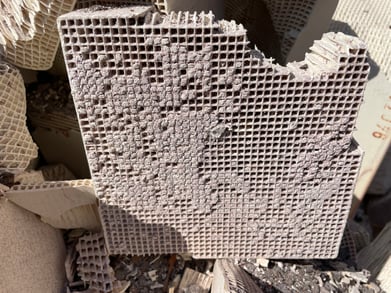
In coating and curing operations, silicone species may vaporize and be transported with the process exhaust. When exposed to elevated oxidation temperatures, silicone compounds can form inorganic silicon dioxide (SiO₂) particulate. A commonly cited threshold for significant inorganic particulate formation is temperatures above approximately 1,300°F (704°C). Unlike organic VOCs, SiO₂ is not combustible and cannot be removed by simply increasing oxidation temperature. Instead, SiO₂ can adhere to hot metallic and ceramic surfaces, forming insulating boundary layers that reduce heat transfer and thermal efficiency, increasing system pressure drop, and interfering with mechanical components.
3. Where Silicone Appears: Application Profiles
Silicone compounds can appear in many industries where coatings, inks, adhesives, or surface treatments are applied and then dried or cured. The examples below illustrate common process types and where silicone is most likely to enter the exhaust stream.
3.1 Adhesive Manufacturing and Adhesive Coating
Pressure-sensitive and specialty adhesives may include silicone ingredients or generate silicone-derived compounds Some applications produce high particulate carryover or high SiO₂ loading Typical risk: accelerated plugging/fouling—design for rapid cleanout and predictable maintenance
Automotive coating systems commonly include spray application zones (booths), flash-off areas, and bake ovens Silicone-containing compounds may be present as formulation ingredients (e.g., surface tension modifiers, flow/leveling agents, slip/mar additives), and can volatilize during flash and bake Typical risk: long-run deposition on oxidizer internals—manage via design margins, inspection access, and maintenance planning
Spray and roll-coat finishing lines (industrial parts, appliances, furniture, general manufacturing) Exhaust streams may be high-volume/dilute (spray booths) or hot/moderate concentration (cure ovens) Typical risk: deposition patterns depend on temperature profile and residence time prior to the oxidizer
Protective and functional coatings and inks applied to packaging substrates Dryers and cure ovens exhaust VOCs with possible silicone-containing additives Typical risk: gradual fouling and efficiency loss if cleanability is not addressed
Release coatings for paper and film; functional coatings on flexible webs Coating line dryers volatilize solvents and silicone species into dryer exhaust Typical risk: continuous SiO₂ accumulation on hot heat‑recovery surfaces and/or ceramic media
4. Impact of SiO₂ on Common VOC Control Technologies
SiO₂ affects oxidizer technologies differently. Understanding the dominant failure modes helps select the appropriate technology and the design features required for reliability.
| Technology |
Primary SiO₂ Related Risk |
Design / Operating Focus |
| Catalytic Oxidizer |
Catalyst poisoning and loss of activity when SiO₂ deposits on catalyst surfaces |
Avoid or qualify carefully for silicone; if used, incorporate upstream controls and expect catalyst management |
| Regenerative Thermal Oxidizer (RTO) |
Ceramic media fouling/plugging; valve fouling; increasing pressure drop and reduced thermal performance |
Media selection/geometry, cleanability strategy, monitoring, and pressure margin |
| Recuperative Thermal Oxidizer |
Heat exchanger deposition and boundary layer formation reducing heat transfer; potential tube fouling |
Confine deposition to accessible surfaces; use mechanical cleanout provisions and maintain velocities |
5. Technology Selection Guidance for Silicone-Laden Exhaust Streams
Thermal oxidizer selection should be based on exhaust flow rate, VOC concentration and variability, lower explosive limit (LEL) considerations, and the expected silicone/SiO₂ loading. When all other factors are equal, high-efficiency RTOs are often preferred for large, dilute exhaust streams due to heat recovery performance; however, high silicone loading or heavy particulate carryover may favor recuperative designs engineered for rapid cleanout.
- Large airflow, low-to-moderate VOC concentration coating and finishing operations (e.g., many spray and web coating processes)
- Applications where heat recovery and fuel savings are primary lifecycle drivers
- Facilities requiring high destruction performance with robust, long-term duty
Silicone-Capable RTO Design Features
- Optimized ceramic media geometry to reduce plugging susceptibility
- Media materials to reduce adhesion sites where silicon species can deposit and solidify
- Controlled bake-out features: while bake-out cannot combust SiO₂, temperature control can promote controlled shedding and facilitate planned cleanouts
- Upstream filtration where particulate carryover is expected, especially during cold start / cooldown conditions
- Increased fan static pressure margin and monitoring (pressure drop and thermal performance) to schedule maintenance based on condition
- Higher silicone/SiO₂ loading where predictable mechanical cleanout is critical
- Processes that generate particulate carryover or experience frequent cycling
- Operations where confining deposition to accessible metallic heat-transfer surfaces improves maintainability
Silicone-Capable Recuperative Design Features
- Heat exchanger design that intentionally routes particulate-laden exhaust through accessible passages for cleaning
- Geometry and velocities that reduce deposit adhesion and support mechanical removal
- Transitions/plenums that promote dropout and provide access for vacuum removal
- Internal cleaning devices and straightforward access for fast restoration of thermal efficiency
6. Special Considerations for Automotive Coatings
Automotive coating systems typically include multiple emission points—spray booths, flash-off zones, and bake ovens—each with different temperature and dilution characteristics. Silicone-containing additives used to control surface properties can volatilize during flash and bake and follow the VOC stream to the oxidizer. As a result, silicone management should be addressed during early project definition (stream characterization, expected operating profile, and maintenance planning).
- Spray booth exhaust: typically very high airflow and dilute VOC; oxidizer selection is often driven by lifecycle energy cost and heat recovery strategy.
- Bake oven exhaust: hotter exhaust with VOCs and volatilized additives; temperature profile may influence where SiO₂ forms and deposits.
- Reliability approach: emphasize access for inspection, pressure margin, and condition-based maintenance to prevent unexpected downtime.
- System integration: define interlocks and operating envelopes to address LEL safety and transient conditions.
7. Example: Managing Silicone-Derived Particulate During Transients
In one pressure-sensitive tape application, a dedicated 7,000 SCFM baghouse was installed to capture silicon dioxide particulate during cold-start purge conditions. As the oxidizer cools, residual SiO₂ on internal surfaces can shed; capturing this material during transient operation can reduce particulate discharge and protect downstream components.
8. Practical Implementation Checklist (Engineering and Operations)
- Characterize each exhaust source: airflow, temperature, VOC/HAP composition and variability, and any particulate or silicone-containing constituents.
- Define destruction performance requirements (e.g., ≥98% DRE or higher) and applicable permitting constraints.
- Evaluate LEL and safety envelope; incorporate bypass/dilution strategies where necessary.
- Select technology based on silicone loading and cleanability needs: RTO for high-volume/dilute streams, recuperative designs where mechanical cleanout dominates lifecycle reliability.
- Engineer access and maintenance provisions: inspection doors, cleanout ports, internal cleaning devices (as applicable), and a monitoring plan based on pressure drop and thermal performance.
- Plan for transients: cold starts, shutdowns, and cycles where SiO₂ shedding can occur.
9. Conclusion
Silicone-containing coatings and surface finishing processes span many industries—from web coating and converting to industrial finishing and automotive paint lines. Successful VOC control for these applications requires combining proven thermal oxidation performance with design features and operating practices that manage silicon dioxide particulate formation and deposition. Selecting the right technology and engineering for cleanability and maintainability are key to long-term compliance, high uptime, and predictable operating cost.