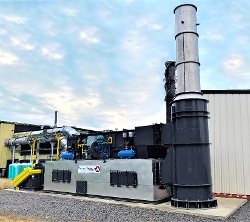
Florida Air Permitting: How CPI Supports Your Compliance Process
CPI designs and builds oxidizer systems — we are not a permitting firm, and every Florida facility's permit obligations depend on details specific to that site. Engaging an air permitting professional who is familiar not just with federal requirements, but with Florida's air permitting rules, is strongly recommended.
Here's how CPI fits into that process:
- Technical data your permit application will need. Emission rates, destruction/removal efficiency, stack parameters, fuel usage, and control technology specifications, delivered as part of every proposal.
- A design matched to your compliance target. Our applications engineering team coordinates with the parties responsible for your permitting so the oxidizer is sized to meet your permit's destruction efficiency and reporting requirements from day one.
- Ongoing support once you're operating. Equipment performance data for emissions reporting or agency inspections, whenever your compliance team needs it.
- A track record Florida regulators already recognize. CPI oxidizer systems are permitted and operating across Florida, helping our customers stay in compliance with their permit obligations.
Florida Air Permitting Rules for Oxidizers
- Permitting authority: Florida Department of Environmental Protection (FDEP), Division of Air Resource Management — statewide, with a notable exception (see below)
- EPA region: U.S. EPA Region 4 (Southeast)
- Local delegation exceptions: Florida approves eight local air pollution control programs, and six of them — including Miami-Dade, Broward, Hillsborough, and Palm Beach — hold delegated authority to issue air construction and operating permits directly within their jurisdiction, rather than through FDEP. This gives Florida more local permitting jurisdictions than any other state in CPI's current rollout.
- Permit types: an Air Construction Permit prior to building or modifying a source, a Title V Air Operation Permit for major sources, and Air General Permits for certain standardized source categories
Supporting Your Project Team
Whether your Florida project runs through an outside environmental consultant, an in-house EHS group, or your engineering team, CPI works alongside them, offering:
- BACT/MACT analysis support, with the technical data needed to weigh control technology options.
- A real installation history in Florida that regulators have already reviewed and accepted.
- Turn-key project support spanning evaluation through commissioning, including installation estimates.
- A 24-hour Technical Service Group standing by well after startup.
Environmental consultants can find CPI's dedicated resources, including project support details and client examples, here: Environmental Consultant Resources →
"They're very straight-up, stand-up people." — Director, Air Emissions Testing Firm
Aftermarket Service & Support — Florida
CPI's aftermarket service is performed by direct CPI employees — not third-party contractors — so Florida facilities get factory-trained technicians who know CPI equipment inside and out.
- Service performed by CPI's own technicians
- Preventive maintenance
- Emergency service, including 24/7 phone support
- Annual inspections and testing support, helping facilities meet inspection or maintenance requirements that may be specified in their air permit
Schedule Florida Service →
Frequently Asked Questions
Can CPI manufacture a regenerative thermal oxidizer for a Florida facility?
Yes. CPI designs and manufactures custom RTOs, catalytic oxidizers, and thermal oxidizers for Florida manufacturers, built on successful implementations throughout Florida and nationwide.
Are there CPI oxidizers already running in Florida today?
Yes — CPI oxidizer systems are installed and operating at Florida facilities, permitted and accepted by the applicable agency. That in-state history means Florida regulators are already familiar with how CPI designs and documents its systems.
Does my facility apply through FDEP, or through a local air pollution control program?
It depends on location. Facilities in jurisdictions like Miami-Dade, Broward, Hillsborough, or Palm Beach counties generally apply through that county's own delegated air program; facilities elsewhere in the state apply through FDEP. Your permitting consultant, EHS team, or engineering group can confirm which authority applies to your site.
Will CPI service equipment it didn't originally manufacture?
Yes. CPI services most makes and models of regenerative thermal oxidizers, catalytic oxidizers, and thermal oxidizers, not only the systems we built ourselves.
Does CPI manage FDEP (or local program) permitting on our behalf?
No. CPI is not a permitting firm. We recommend confirming your specific requirements with an environmental consultant, EHS resource, or engineering team - CPI's role is supplying the oxidizer information that process depends on.
Is CPI a resource for environmental consultants working on Florida projects?
Yes. CPI works closely with environmental consultants on BACT/MACT analysis and project support, backed by a proven track record of oxidizers already operating in Florida.
Explore More
See where CPI provides oxidizer aftermarket service by state: CPI RTO Nationwide Support — All Locations
CPI's Core Technology:
Regenerative Thermal Oxidizers | Thermal Oxidizers | Catalytic Oxidizers
For Environmental Consultants, EHS & Engineering Teams:
Environmental Consultant Resources & Support →