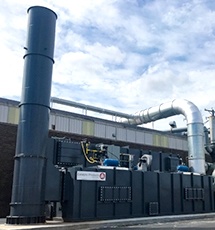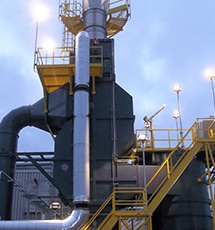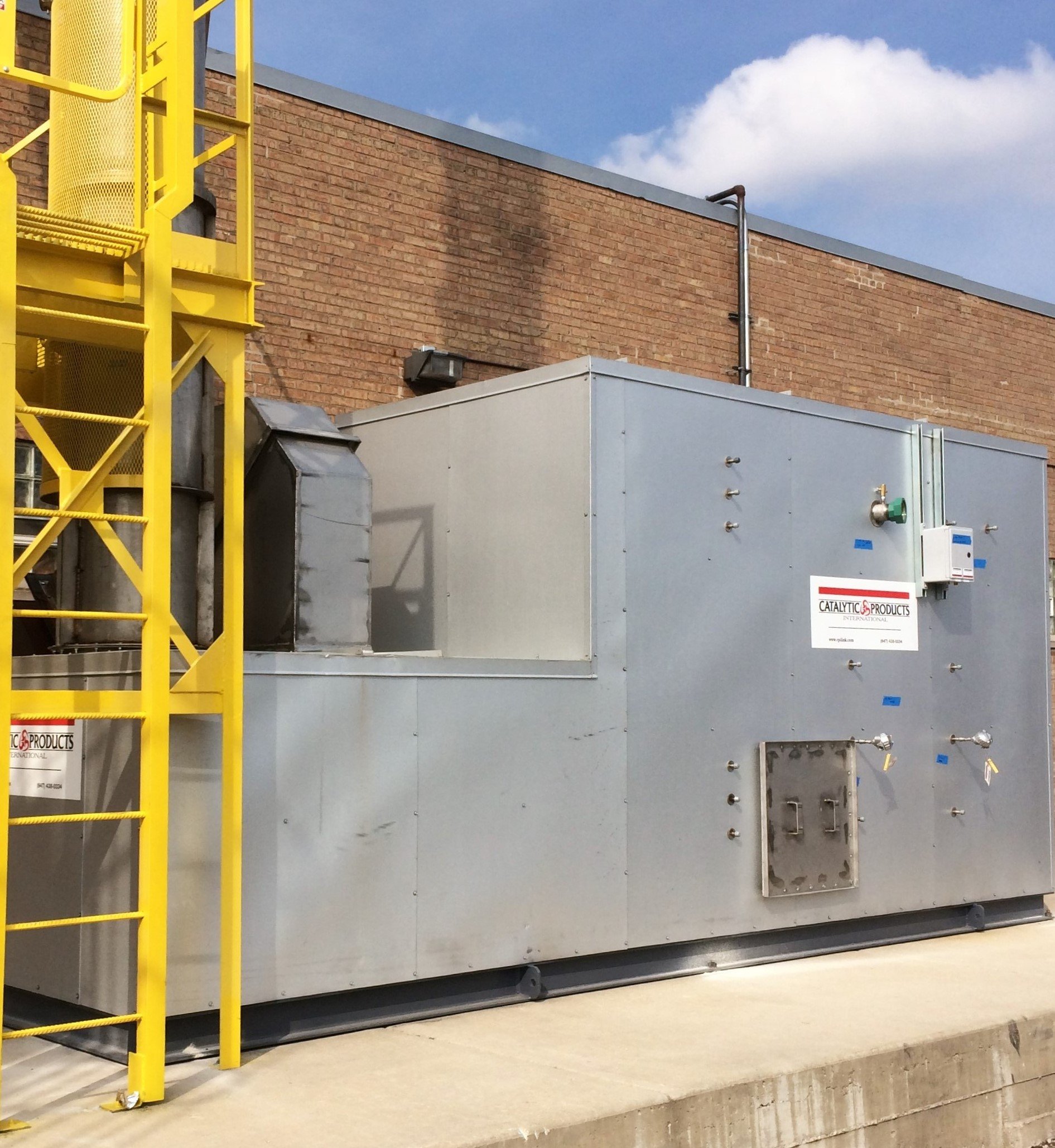
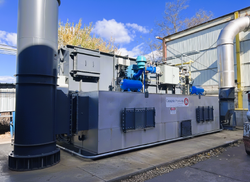
Catalytic Products International (CPI) engineered, supplied and installed a 15,000 SCFM TRITON-15.95 Regenerative Thermal Oxidizer (RTO) for steel drum reconditioning facility in the Northeastern USA.
The project was executed to ensure the facility’s emission sources complied with applicable state air pollution control rules and federal Clean Air Act requirements. The RTO installation was necessary to reduce facility-wide emissions of volatile organic compounds (VOCs) generated from drum washing, residual chemical removal, and surface‑coating operation.
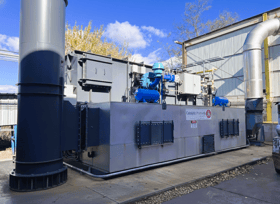 Process Type: Drum: Wash line and paint spray booth
- VOC: Ethylene glycol, Hexane, Toluene, Methyl alcohol
- Process Air Volume: 15,000 scfm
- Control Type: Regenerative Thermal Oxidizer (RTO)
- Destruction Rate of Efficiency (DRE): 98%
- Installation: RTO, ductwork, dampers, & exhaust stack
The facility performs large-scale drum reconditioning, including internal washing, external cleaning, lead testing, and repainting activities. These processes generate VOC emissions from materials such as ethylene glycol, hexane, toluene, and methanol. Prior to the control installation, emissions from the wash stations, coating line, and liquid storage were vented independently, contributing to increased regulatory scrutiny. To resolve these issues, a unified VOC control strategy was implemented to capture and route the emissions to a new RTO system for high-efficiency destruction.
Control Technology Compliance Demonstration
To meet the permit‑required VOC reduction efficiency, CPI implemented a unified capture system that channels emissions from both the wash operations and the paint spray booth to the RTO. The TRITON‑15.95 RTO was selected to satisfy regulatory performance standards requiring:
- ≥98% VOC destruction efficiency (DRE)
- Demonstrated thermal oxidation at compliant combustion temperatures and residence times
- Continuous and stable operation consistent with permit monitoring and recordkeeping requirements
The RTO uses regenerative ceramic media to preheat incoming process air streams, achieving 95% thermal efficiency. VOCs are oxidized in a controlled high‑temperature environment, converting them into non‑hazardous byproducts (CO₂ and H₂O) while reducing auxiliary fuel consumption and meeting mandated operating parameters.
Design, Installation & Regulatory Operating Conditions
CPI provided engineering, design and supply of the Regenerative Thermal Oxidizer (RTO), on a customer provided concrete pad. RTO installation included rigging, ductwork, dampers, exhaust stack and system startup. To minimize downtime, CPI completed significant portions of the installation prior to the RTO’s arrival. The team then performed media loading, system tie‑ins, and commissioning, enabling rapid transition back to production operations.
Minimizing Downtime and Ensuring Compliance Readiness
To support uninterrupted facility operations, CPI pre‑assembled and pre‑staged major system components, completing all feasible installation activities ahead of final equipment arrival. Once onsite, CPI completed the ROT install, mechanical tie‑ins, controls integration, and system commissioning. The final configuration was validated to operate within permitted limits, enabling the facility to resume production under a compliant, single‑point controlled exhaust system.
CPI has been “Enabling Clean Production™ Since 1969” and continues as a leading supplier and manufacturer of Regenerative Thermal Oxidizers (RTO) for large and small air volume VOC applications. CPI is at the forefront in providing industries including metal coating facilities with solutions to their air pollution VOC control needs.
Today, CPI partners with its customers as a trusted resource in resolving the most complex air pollution and energy conservation problems. We provide our customers with innovative and cost-conscious solutions to their most complex VOC, NOx, and Odor pollution challenges. Our equipment is also at work meeting energy conservation strategies and minimizing greenhouse gas (GHG) emissions.