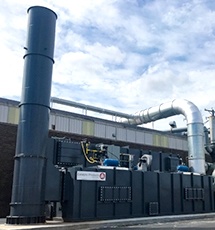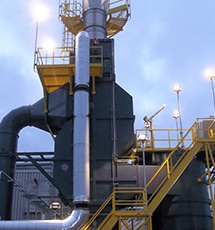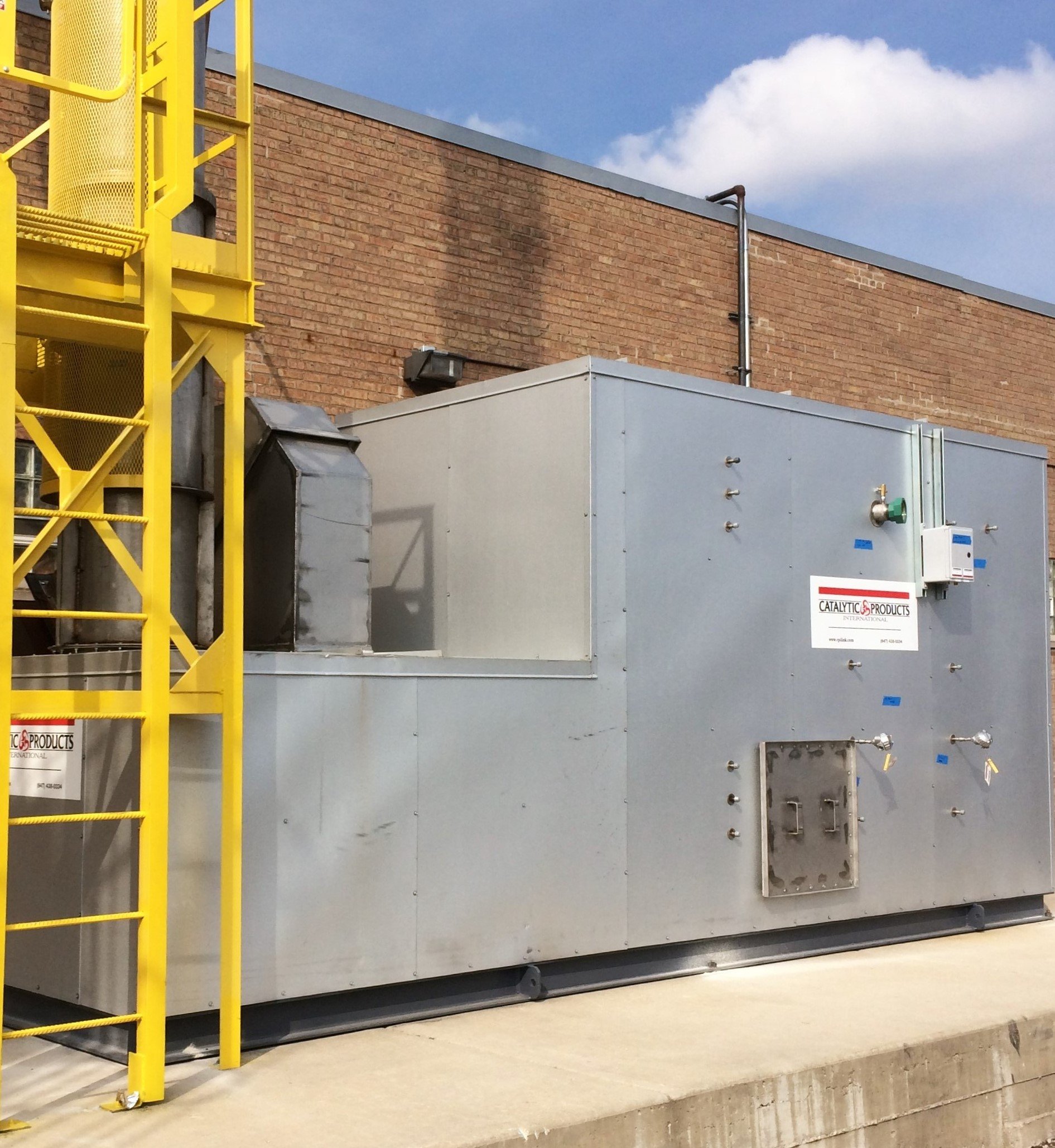
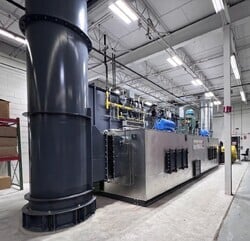
A Midwest metal parts finishing facility worked with CPI to install a Regenerative Thermal Oxidizer (RTO) to control volatile organic compound (VOC) emissions generated from multiple coating and cleaning operations. The system was designed to provide reliable, long‑term compliance with applicable federal and state air quality regulations while maintaining high destruction efficiency and efficient energy utilization.
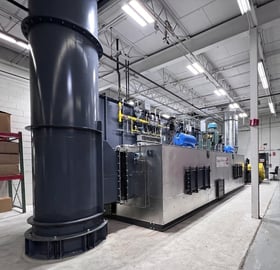 Industry: Metal Parts Finishing/Coating
 - VOC: Xylene, Toluene, MEK and Acetone
- Process Air Volume: 20,000 scfm
- Control Type: Regenerative Thermal Oxidizer (RTO)
- Destruction Rate of Efficiency (DRE): 98%
- Installation: RTO, stack, fans, ductwork, dampers
Project Scope
CPI provided a turnkey Regenerative Thermal Oxidizer (RTO)–based control solution designed to support permit‑compliant control of VOC emissions from metal parts coating operations, from system design through startup and commissioning.
- Designed and supplied a 20,000 SCFM Regenerative Thermal Oxidizer (RTO) as an add‑on control device for VOC emissions from coating and associated operations
- Engineered the RTO to achieve high VOC destruction efficiency consistent with regulatory expectations for regenerative thermal oxidation of hydrocarbon VOC streams
- Integrated the RTO with permanent total enclosure based capture systems to ensure regulated exhaust streams are continuously routed to control during coating operations
- Installed the RTO on a customer‑provided indoor concrete pad, including associated ductwork, fans, dampers, and exhaust stack
- Provided startup and commissioning services to verify proper operation at intended design and permit-relevant conditions
- Delivered a complete system configured for continuous operation during production, consistent with add-on control device expectations in air permits
Applicable Regulatory Frameworks
The Regenerative Thermal Oxidizer (RTO) system was implemented as an add‑on air pollution control device to support compliance with applicable federal and state air quality regulations governing emissions from metal parts coating and associated cleaning operations.
Facilities performing metal parts coating and related operations are commonly subject to the National Emission Standards for Hazardous Air Pollutants (NESHAP) under the Clean Air Act. These regulations allow the use of add‑on control devices, such as RTOs, as a compliance pathway when specified performance and operating requirements are met. Under these frameworks:
- Regenerative thermal oxidizers are recognized as effective control devices for organic HAP and VOC emissions when operated at sufficient temperature, residence time, and mixing conditions.
- Compliance is demonstrated through enforceable operating parameters (e.g., combustion chamber temperature) and performance testing rather than continuous outlet concentration monitoring.
- Overall emission reduction requirements may incorporate both capture efficiency and destruction efficiency, depending on the compliance option selected.
EPA guidance identifies regenerative thermal oxidation as a Best Demonstrated Technology for controlling hydrocarbon VOC emissions from industrial coating operations due to its high destruction efficiency and energy recovery capability.
State and Local Air Permitting Requirements
In addition to federal NESHAP requirements, metal parts coating facilities are subject to state‑level VOC regulations and construction/operating permit conditions. These programs typically require that:
- Add‑on control devices achieve a specified minimum overall VOC reduction (often ≥90%)
- Control devices operate continuously whenever regulated emission units are operating
- Enforceable operating limits are established and maintained to ensure ongoing compliance
- Monitoring, recordkeeping, and reporting provisions are incorporated into the permit
Regenerative Thermal Oxidizers (RTO) are widely accepted by state permitting authorities as a compliant control technology when properly designed, installed, and operated in accordance with permit conditions.
Role of the RTO in Compliance Assurance
The RTO supports regulatory compliance by:
- Providing high and consistent destruction efficiency for VOC‑containing exhaust streams
- Allowing establishment of clear, enforceable operating limits based on combustion temperature and system design
- Supporting periodic performance testing to verify destruction efficiency and overall control effectiveness
- Enabling long‑term compliance through stable operation and energy‑efficient heat recovery
These characteristics align with regulatory expectations for add‑on control devices used to comply with both federal NESHAP standards and state VOC emission limitations.
Beyond installation, CPI enables long term clean production through Preventative Maintenance services that support consistent RTO performance and ongoing compliance with permit operating conditions.
About CPI
CPI has extensive experience providing air pollution control solutions for industrial coating operations requiring reliable VOC, HAP, and CO emissions control
Since 1969, CPI has been “Enabling Clean Production™” by delivering innovative, cost‑effective solutions for VOC, HAP, NOx, and odor control.
Oxidizer preventative maintenance, service, and support provided by CPI across the Midwestern USA including Wisconsin, Illinois, Indiana, Minnesota, Michigan, Ohio, Iowa, Kansas, and Missouri.